I love Amazon. I use it constantly, and from a business and marketing perspective, I think they have done a remarkable number of things right. That’s part of the reason I was so stunned to read the FTC’s lawsuit filed yesterday against Amazon, joined by 22 state attorneys general.
If the allegations are true, this isn’t just Amazon finding another way to make advertising more expensive. As someone who works with digital advertising every day, I think it represents a pretty serious breach of trust between an advertising platform and the businesses spending money on it.
The easiest way I can explain why is to compare it to eBay.
Think About Bidding on eBay
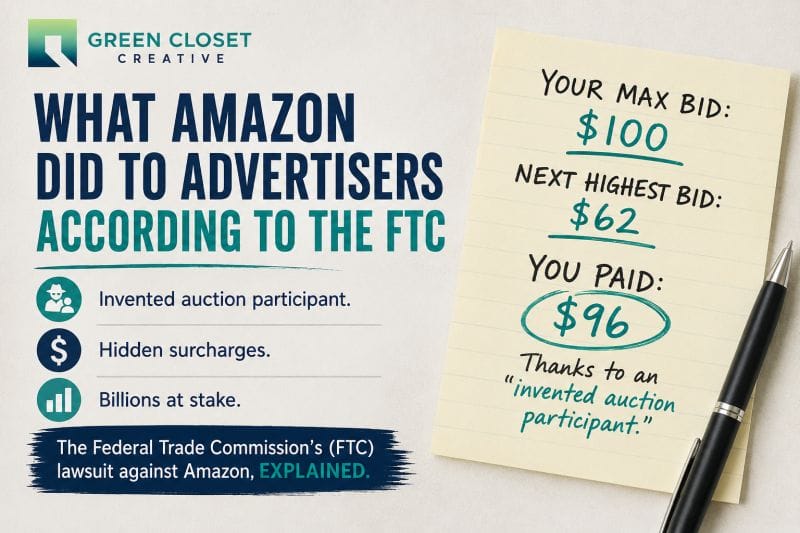
Let’s say you find a purse on eBay and decide you’re willing to pay up to $100 for it. You enter $100 as your maximum bid. The next-highest bidder is only willing to pay $62.
You don’t expect to be charged $100 just because you told eBay you were willing to go that high. You expect to pay whatever amount is necessary to beat the next-highest bidder. Your $100 is a ceiling, not an invitation to charge you $100.
Now imagine finding out that eBay knew your maximum was $100 and secretly introduced an imaginary bidder at $95. Suddenly you’re paying $96 for the purse, even though no actual person was willing to pay anywhere near that amount.
That is essentially what the FTC is accusing Amazon of doing with advertising.
Why This Is Such a Big Deal to Advertisers
At Green Closet Creative, setting bids, budgets and targets on advertising platforms is part of our everyday work. Amazon, Google, Meta and other platforms all have their own auction systems and they don’t operate exactly the same way, but there is something fundamental they have in common: advertisers have to give the platform information about what we’re willing to spend.
We do that with an enormous amount of implicit trust.
When I tell an advertising platform the maximum I’m willing to pay, I am giving it information it can use to participate in the auction on my behalf. I’m not saying, “Great, please find a way to charge me every penny of that.”
That distinction matters.
According to the FTC, Amazon told advertisers it was operating a generalized second-price auction. In very simple terms, advertisers were led to understand that if they won, the price would be determined by what was necessary to beat the competition rather than simply defaulting to their maximum bid.
The FTC alleges that beginning in 2019, Amazon quietly introduced an undisclosed “soft reserve price” that increased what advertisers paid.
And this is the part that really got my attention.
The complaint quotes internal Amazon documents referring to an “invented auction participant.”
If you’re an advertiser, read that again.
According to the FTC’s allegations, Amazon was essentially inserting an artificial competitor into the pricing calculation, allowing Amazon to charge advertisers more than the actual competition among advertisers would have produced. The FTC goes so far as to characterize these as essentially shill bids.
To be clear, these are allegations. Amazon has not been found liable, and the company will have the opportunity to defend its practices in court. But the allegations themselves are incredibly troubling.
The Numbers Are Enormous
The FTC says more than one million brands and sellers were affected and that Amazon’s practices may have extracted tens of billions of dollars from advertising customers. More than 500,000 small and medium-sized businesses participated in these advertising auctions.
The change over time is especially interesting.
According to the complaint, Sponsored Products advertisers paid their own bid approximately 30% to 40% of the time in 2021. By 2022, it was 70%. By 2024, it was approximately 80%.
Think about what that means. Advertisers were telling Amazon the maximum they were willing to pay, believing that the auction itself would determine what they actually needed to pay. Yet by 2024, according to the FTC, they were ending up paying that maximum bid roughly four out of every five times.
If advertisers had understood that was happening, wouldn’t they simply have started bidding less?
Apparently Amazon thought so too.
That’s the Part I Find Most Troubling
The FTC complaint alleges that Amazon knew advertisers believed they were participating in a traditional second-price auction and knew they would change their bidding behavior if they understood what was actually happening.
Internal documents quoted in the complaint reportedly warned that revealing the surcharges could cause “irrevocable damage to advertiser trust” and lead advertisers to lower their bids, resulting in substantial revenue losses for Amazon.
That, to me, is much more troubling than the fact that Amazon wanted to increase its advertising revenue. Of course Amazon wants to make more money from advertising. Google does. Meta does. Every advertising company does.
Raise your prices if you want to raise your prices. Change the rules of your auction if you want to change them. Tell advertisers that the economics of the platform have changed and let us decide what we’re willing to pay.
What you can’t do is tell advertisers the game is being played by one set of rules while secretly playing it by another.
And Yes, I Think This Is a Big Black Eye for Amazon
I’m usually the person defending Amazon. I think the company has done extraordinary things for consumers, transformed retail and created opportunities for countless small businesses.
But if these allegations are proven true, shame on Amazon.
The company wasn’t operating from an equal position with its advertisers. Amazon controlled the marketplace, wrote the rules, ran the auction, possessed the data and knew everyone’s bids. Advertisers had no realistic way to see what was happening inside each auction.
The only thing that makes that arrangement work is trust.
And that’s why I think this lawsuit matters well beyond Amazon.
Digital advertising is moving further and further toward automation. We’re constantly being asked to hand platforms more control: give us your budget, tell us what a conversion is worth, give us your target return and let our algorithm take it from there.
As advertisers, we already have remarkably little visibility into what happens after we hand over that information. We can’t watch every auction. We don’t know every competing bid. We certainly can’t see everything happening inside proprietary algorithms making thousands of decisions for us.
We have to trust the platform.
If the FTC’s allegations are true, Amazon took advantage of precisely that trust. And regardless of what ultimately happens in court, every business spending money on digital advertising should be paying very close attention to this case.